
Image: ClarkMills
Brandy snaps do not contain brandy and the origin of the name is obscure. It first appears in glossaries of Northcountry words starting with that of John Trotter Brockett in 1825, with a suggestion that the name comes from 'branded' as in burned.
In the first known receipt (below) a distinction is made between 'Italian Jumbles' (see Jumbles), which are turned or rolled into a cone or cylinder, and 'brandy snaps' which are not, presumably being left as flat biscuits.
 Original Receipt in George Read's 'Biscuit and Gingerbread Baker's Assistant' of 1854;
Italian Jumbles or Brandy Snaps
6 lbs of flour 7 lbs of good rich sugar 1 lb of butter or lard 2 oz of ginger or allspice 6 lbs of raw treacle. Rub the butter in with the flour mix in the sugar and spice make a bay pour in the treacle and make the whole into a moderately stiff paste this improves by keeping. Roll it out into sheets rather more than the eighth of an inch in thickness cut them out with a spice cake cutter a plain round cutter three inches and an eighth in diameter put them on tins well buttered about three inches asunder wash the tops with water and bake them in a cool oven. They will be to be baked enough if on pressing the cake in the centre with the top of your finger it will rise up again. When they are baked and a little cool cut them from the tins by passing a thin knife under them turn them whilst warm in the form of a cone the same as the grocers make up their sugar papers or turn them round a stick as the last If they should get too cold to turn put them again into the oven to warm.
Brandy Snaps are the same as these without being turned. The dough is best made up a week or fortnight before it is required to be used.
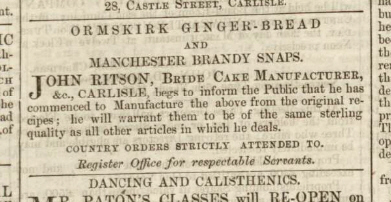
Advertisement for 'Manchester Brandy Snaps'
Carlisle Journal - Friday 09 March 1855