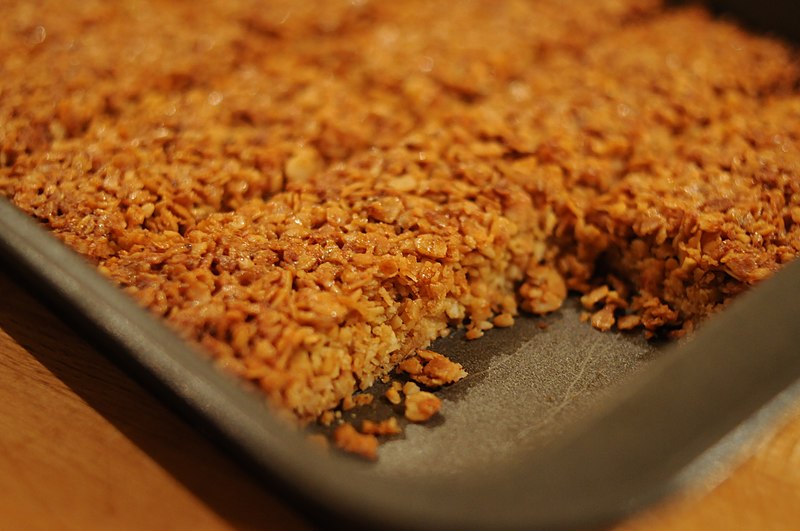
Modern Flapjacks in a baking tray.
Photo: "sk8geek"
Over the centuries the word 'flapjack' has been applied to all sorts of flattish, sweetish cakes, pancakes and pastries (see; Flap Jack). The word itself has has - according to the OED - been used at various times to mean a form of somersault, a kind of hydraulic machine, the lapwing or a vanity case for face-powder as well as various eatables. Flap in this context probably means ‘toss’, or 'fold' and used also to be a sort of apple turnover as with the Sussex Flap Jack.
First recorded as a food in England in John Taylor's jokey poem 'Jack a Lent' of 1620 with; "A Flap~iack, which in our translation is call'd a Pancake", this remains the meaning in some parts of North America, and seems to have been so in England until quite recently. For example, this, from 1933, is clearly a pancake or drop-scone..
 Original Receipt from 'Nottingham Evening Post' - Thursday 7 December 1933
A recipe for flapjacks: Mix 2oz. flour and half-teaspoonful baking powder with half-gill cold water into a batter, add 1/2 oz. currants, and fry in hot fat on both sides. Serve hot with sifted sugar. Enough for four people.
The name seems to have settled down to its present sweet, oaty meaning somewhere in the North in the 1930's, though the OED was able to say as late as 1989 that the name was still "Not known to some correspondents in S. England."
Original Receipt from 'Taunton Courier, and Western Advertiser' - Saturday 23 February 1957FLAPJACKS
Four ounces each of margarine, sugar and porridge oats, place the margarine and sugar in saucepan, stir until the sugar is dissolved, then stir the oats. Mix all well in the saucepan, press into a greased tin. and bake in a moderate oven for 25 minutes. Cut into triangles and leave until cold
The name appears in the play 'Pericles, Prince of Tyre', possibly by William Shakespeare: "Come, thou shalt go home, and we'll have flesh for holidays, fish for fasting-days, and moreo'er puddings and flap-jacks, and thou shalt be welcome."
2015