In texts before about 1500 'kipper' may refer to a male salmon, or sea trout, during the spawning season. The 1848 'Chambers's Information for People' has; "The adult fish [salmon] having spawned, being out of condition, and unfit for food..are..termed kelts; the male fish is sometimes also called a kipper, and the female a shedder or baggit."
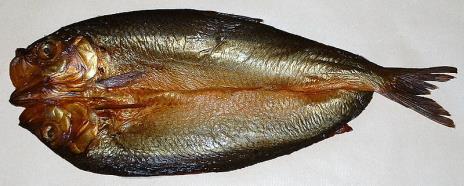
A Kipper
 Original Receipt from 'The Whole Art of Curing' by James Robinson (Robinson 1847)
KIPPERED HADDOCKS.
In the absence of Finnon Haddies, you may take some fresh ones and split them open at the belly, cleaning them well with salt and water, and taking off" the heads. Then lay them completely open leaving the back bone in sight, and put them into the following pickle: -
Soft water - - - - 1 gallon.
Brown sugar - - - - i lb.
Saltpetre - - - - 1 oz.
Common salt - - - - 1 lb.
Bay salt - - - - - 1 lb.
If the fish are large, let them remain in pickle six hours, then take them out, and let them drip from the frames for three hours, then put them into the chimney, and smoke them well for twelve or fourteen hours longer. If you have any dried fern at hand, it may be buried in the sawdust when you add to the fire, but do not allow it to blaze away, or it will be of no effect.
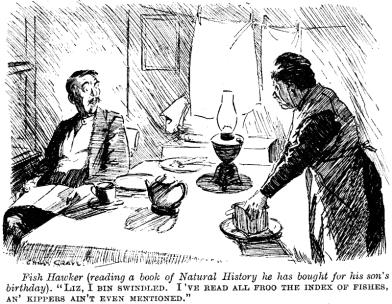
Punch, 1920. Cartoon May 26th, poem June 23rd
There was a young man of the Peak
Who had kippers for tea once a week;
As he hated the taste
It was rather a waste,
But it gave him a feeling of chic.
Search Foods of England for more about: Kippers...