This is found in the 'The Forme of Cury' by the Chief Master-Cook of King Richard II - Foods of England has the Full Text HERE...
 Original Receipt in 'The Forme of Cury' by the Chief Master-Cook of King Richard II, c1390 (Cury 1390)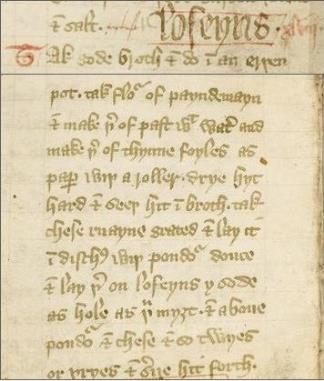
John Rylands Library
Loseyns:
Take gode broth and do in an erthen pot, take flour of payndemayn and make þerof past with water. and make þerof thynne foyles as paper with a roller, drye it harde and seeþ it in broth take Chese ruayn grated and lay it in disshes with powdour douce. and lay þeron loseyns isode as hoole as þou mizt and above powdour and chese, and so twyse or thryse, & serue it forth.
Take good broth and put in an earthenware pot, take fine white flour and make with it a paste with water, and make from that foils as thin as paper with a roller, dry them hard and seethe them in the broth. Take grated soft cheese and lay it in dishes with spice powder, and lay over it the pasta layers as many and as thick as you wish, and above powder and cheese, and so two or three times, & serve it forth.
This dish has been claimed as the origin of Lasagne, being layers of pasta with a stewed meat broth and a cheese sauce. It is more likely that the Old English 'Loseyns' and Italian 'Lasagne' both derive from the layered pasta 'lagana' dishes known to the Romans and as far back as the 1st century BC writings of Horace. However, Loseyns or Lossenges appears elsewhere in Old English cookbooks (Austin 1440, Noble Boke 1480) as a simple pasta shape.