2020
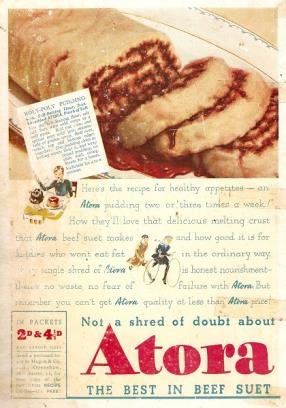
Although this form is well-known, there are remarkably few historic receipts for it. Though there are a fair number of literary references. The earliest we can find is in I. Hurlstone's 'Fatal Interview' of 1835; "I have heard such puddings called blankets and sheets, and a hunting pudding; but commonly we call it a rolley polley." 'Notes of a journey from Cornhill to grand Cairo' (W.M. Thackeray, 1846) has "That lady fancied I was looking at her, though, as far as I could see, she had the figure and complexion of a roly-poly pudding"
The 'Paste Pudding' of Eaton 1822 is similar.
 Original Receipt from 'The English Cookery Book' edited by JH Walsh Walsh 1859;
ROLLY-POLLY PUDDING.
865. This well-known pudding is made by rolling out a thin layer of suet or butter paste, as for puddings, upon which either a preserve or dried currants are spread evenly, leaving an inch bare at the edges all round, except on that next the cook, and then the whole is rolled up into a long pudding, closed at the ends by pinching the paste, and enveloped in the same way in a cloth, which is tied with a string at each end, and boiled about one hour.
Original Receipt from 'The Skilful Cook' by Mary Harrison (Harrison 1884)Jam Roly-poly Pudding.
Ingredients--1 lb. of flour.
4, 6, or 8 oz. of suet, finely chopped.
Some red jam.
1 teaspoonful of baking powder.
Method.--Put the flour into a basin, and add to it the suet and baking powder.
Mix it with a little cold water and roll it out.
Spread it with the jam, and roll up in the form of a bolster.
Scald and flour a cloth, and sew, or tie, the pudding firmly in it.
Boil for two hours.
Treacle Roly-poly Pudding.
Make like a jam roly-poly, using treacle instead of jam.