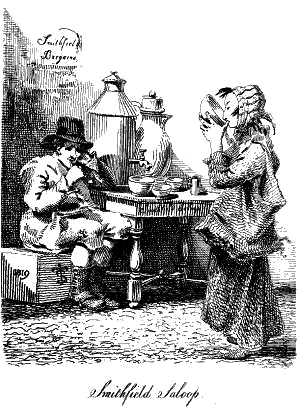
Saloop Seller, from John Smith’s 'Vagabondiana' of 1839
Grieve's 'Modern Herbal' (1931) says that; "Charles Lamb refers to a 'Salopian shop' in Fleet Street, and says that to many tastes it has 'a delicacy beyond the China luxury,' and adds that a basin of it at three-halfpence, accompanied by a slice of bread-and-butter at a halfpenny, is an ideal breakfast for a chimney-sweep. Though Salep is no longer a popular London beverage, before the war it was regularly sold by street merchants in Constantinople as a hot drink during the winter."
Mayhew's 'London Labour and the London Poor' of the 1840's says that; "The vending of tea and coffee, in the streets, was little if at all known twenty years ago, saloop being then the beverage supplied from stalls to the late and early wayfarers."
'A History of the Cries of London' (1882) by Charles Hindley gives one of the traders' cries as being "Here’s fine saloop, both hot and good."
 Original Receipt in 'The Cook and Housekeeper's Dictionary' by Mary Eaton (Eaton 1822);
SALOOP. Boil together a little water, wine, lemon peel, and sugar. Mix in a small quantity of saloop powder, previously rubbed smooth with a little cold water. Stir it all together, and boil it a few minutes.