All early references seem to confirm the Eastern origin - John Tradescant's 'Musæum Tradescantianum: or, A collection of rarities' of 1656 says that Easter eggs were known in Jerusalem, while a series of travellers tales starting with the 1737 'Travels into Muscovy' report them being known in Russia, where Faberge's decorative faux eggs became famous. William Howitt's 'The Rural Life of England' of 1838 refers to the older designation of 'Paschal eggs' being known in the English Midlands and associated with Russians and "the Mohammedans".
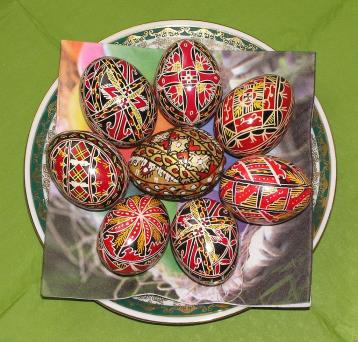
These traditional Eggs are from Ukraine, but similar ones are still made in Iran. Image: L.Kenzel
One of the earliest descriptions we can find is from Lancaster Gazette of Saturday 1 April 1815, which indeed ascribes a Persian origin to them. The author explains how they began with 'Mohammedans' - or 'Muslims' as we would now say - but decorating and giving eggs is know from the ancient Persian 'Shaname' tales so probably predates Islam.
ON EASTER EGGS.
To the Editor of The Lancaster Gazette.
Sir.
A SHORT time before Easter, the children of poor people in this neighbourhood, collect what they call Pace Eggs, probably meaning Paschal Eggs. On Easter Sunday, the children of all ranks amuse themselves with eggs dyed, gilt, and otherwise or- ornamented. It is Well known, that our Easter is celebrated at the same time as the Jewish Passover, viz.- in the first month of the astronomical year, and it is rather singular to observe, that the same custom which is preserved amongst children here, is an ancient observance of Eastern nations; and probably of Heathen origin. It would be amusing to learn how far the ceremony is general in this country, and how it has descended to us. Leaving these inquiries, however; to more learned antiquaries, I send you a passage from Sir John Chardip's Travels, as quoted by Hariner:- The Mahommedans of Persia now observe the first day of every hew year, according to the reckoning of their ancient Heathen country men, namely, the precise day in which the Sun enters into Aries, which is in March- it is now celebrated with great splendour, and one custom is revived, of presenting one another with painted and gilded eggs, some of -them being so curiously done, as to cost three ducats a piece. This it seems was a very ancient custom in Persia, an egg being expressive of the origin and beginning of things."
Lancaster, March 30, 1815